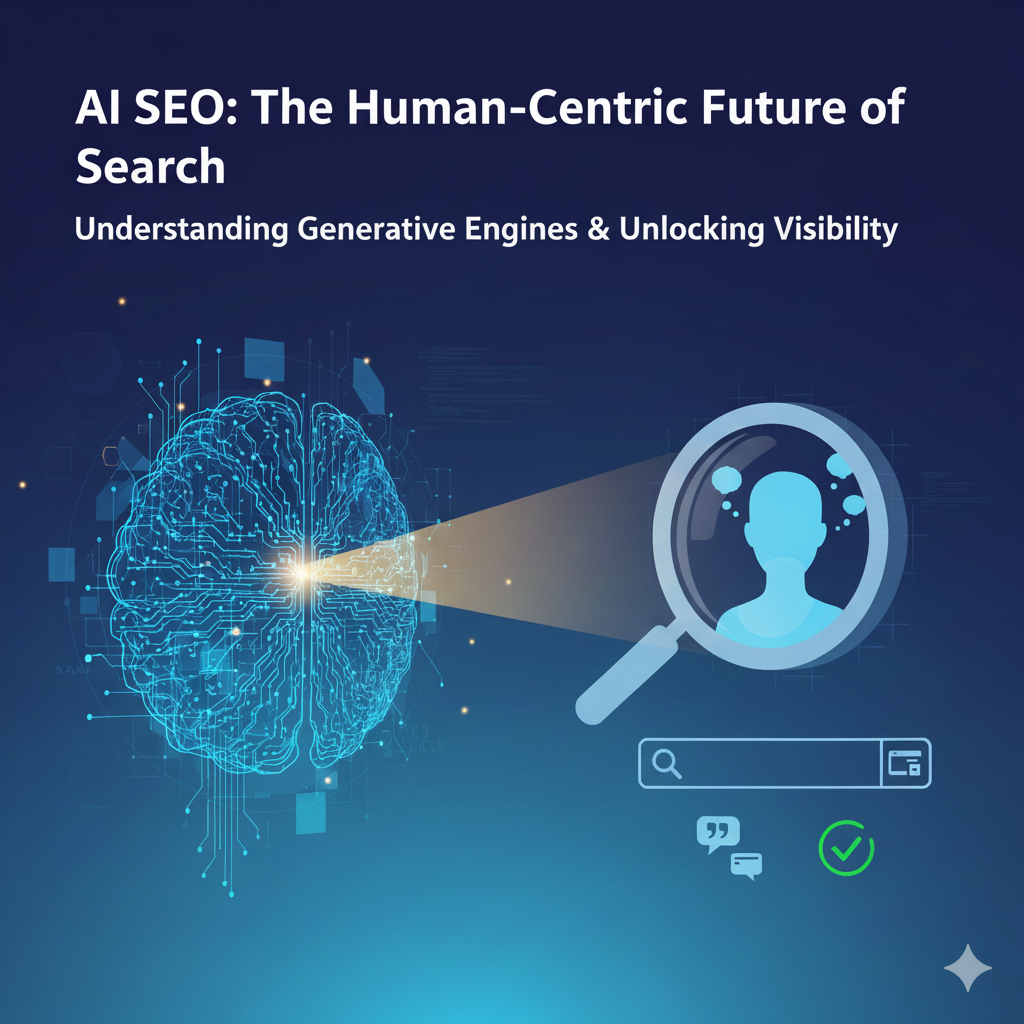
The world of search engine optimization has dramatically evolved. What was once a technical battle fought with links and keyword density is now a nuanced pursuit driven by data and user understanding.
The single biggest force behind this transformation is artificial intelligence.
We are not just talking about using AI tools to write faster content. We are talking about a fundamental shift in how search engines operate and how content must be built to meet these new, smarter algorithms.
This is the era of AI SEO.
It’s the proactive process of optimizing your website and content not just for traditional search ranking signals, but specifically for the advanced machine learning models that power modern search platforms like Google’s Search Generative Experience (SGE), Perplexity, and others.
It’s about making your expertise clear, your answers concise, and your value undeniable to both human readers and sophisticated language models.
This detailed guide breaks down exactly what AI SEO means today and provides actionable strategies to ensure your visibility in the future of search.
The Core Shift: From Keywords to Intent
Traditional SEO focused heavily on matching specific keywords. If a user searched for “best coffee maker,” you optimized for that exact phrase.
The primary change brought by AI is the move toward true semantic understanding, meaning search engines care less about the words themselves and much more about the underlying intent and context of the query.
What is Semantic Search?
Semantic search uses AI technologies such as Natural Language Processing (NLP) and Large Language Models (LLMs) to understand the full meaning of a search query, including its context and the user’s ultimate goal.
It moves beyond simple text matching.
For example, if you search “how tall is the actor who played Thor,” the search engine doesn’t just look for pages with those exact words.
It understands that:
- “Actor who played Thor” refers to the entity Chris Hemsworth.
- “How tall” is an informational intent seeking a measurement.
- The final answer should be a specific height (e.g., 6’3″ or 190 cm).
The algorithm uses its knowledge graph and machine learning models (like Google’s BERT and MUM) to derive this meaning and deliver the most precise answer available.
The Role of User Intent
In AI SEO, optimizing for intent means structuring your content to answer the user’s unspoken need, not just their typed query.
Content must be structured to solve problems quickly and efficiently.
This involves grouping related ideas into topic clusters, ensuring every piece of content addresses a specific stage of the customer journey, and using clear, unambiguous language.
Statistics That Prove AI is the Present of SEO
The integration of AI into search is not a prediction; it is a current reality. Understanding the scale of this change is crucial for budgeting and strategic planning.
Here are a few powerful statistics that illustrate the current landscape:
- Generative Visibility is Key: Google’s AI Overviews now appear in a significant percentage of search results, fundamentally changing the click behavior of users. When an AI Overview appears, organic click-through rates can drop by nearly 4x, according to some analyses, reinforcing the need to optimize for citation over just ranking. (Source: Multiple SEO studies, 2024-2025).
- Market Adoption: According to recent surveys, over 86% of SEO professionals have already integrated AI tools into their strategy, demonstrating that the industry views AI as essential, not optional. (Source: Search Engine Land).
- Efficiency Gains: The efficiency benefits are enormous, with some reports showing that 83% of marketers boosted their productivity with AI, and 84% claim AI helped them create quality content faster. (Source: Industry reports, 2025).
- Traffic Reductions: Some analyses indicate that organic web traffic has been reduced by 15% to 25% due to generative AI search answering queries directly, a phenomenon often called “The Great Decoupling.” This makes every click you do receive more valuable, emphasising the need for high-quality, conversion-focused content. (Source: Semrush/Industry data).
- Focus on Citations: For visibility in AI Overviews and answer engines like Perplexity, ranking highly remains important. For instance, ranking #1 on the traditional SERP gives your content an approximate 33% chance of being cited in an AI Overview. (Source: Omniscient Digital).
These numbers confirm that the game has changed. Your strategy needs to focus on securing a “Share of Voice” within the AI summaries, which often means optimizing for citation rather than just position one.
Core Pillars of an AI SEO Strategy
Optimizing for modern AI-powered search engines requires a strategic shift across content, technical structure, and user trust signals.
1. Generative Engine Optimization (GEO)
GEO is the practice of crafting content specifically so that large language models can easily extract it, summarize it, and use it as a source in their generative responses.
It moves the goalpost from getting clicks to getting cited.
Actionable Steps for GEO:
- Front-Load the Answer: Begin every section or H2 with a concise, direct answer to the question the heading implies. This is often called the “inverted pyramid” approach. Keep this introductory answer block between 40 and 60 words.
- Use Definitive Language: Write with authority. Use clear, factual statements that sound like a definitive answer, as AI models favor text that demonstrates confidence and accuracy.
- Add Explicit Summaries: Use short summary paragraphs after detailed sections to provide easy extraction points for the AI. Consistent structure is the key to clarity for an algorithm.
2. Doubling Down on E-E-A-T
Google’s concept of Experience, Expertise, Authority, and Trustworthiness (E-E-A-T) is more critical than ever, serving as a primary filter for AI systems determining content quality.
AI is excellent at identifying patterns, and it uses E-E-A-T signals to distinguish surface-level content from genuine expertise.
Demonstrating E-E-A-T to AI:
- Show First-Hand Experience: Include proprietary data, original case studies, screenshots of your own work, or documented processes. Content that could only be written by someone with real experience will stand out.
- Robust Author Credentials: Ensure every article has a detailed, professional author bio that explicitly lists relevant professional experience, certifications, or educational background. Link to LinkedIn or other verified expert profiles.
- Timeliness and Accuracy: Set a clear publication date and, crucially, a “last updated” date. AI models heavily favor fresh, verified information, especially in YMYL (Your Money or Your Life) categories like finance and health.
3. Technical Optimization for AI Crawlers
While content is paramount, AI systems still rely on a clean, accessible foundation to crawl and index your pages. Technical SEO is the vehicle that delivers your brilliant content to the AI.
Key Technical Focus Areas:
| Technical Element | AI SEO Importance | Optimization Action |
|---|---|---|
| Schema Markup | Essential for defining entities and relationships. | Use specific JSON-LD schema (e.g., Article, FAQPage, HowTo) to label content structure precisely for quick extraction. |
| Crawlability | AI-driven crawlers need unrestricted access. | Review your robots.txt file and ensure AI-specific crawlers like Google-Extended, GPTBot, or CCBot are not unnecessarily blocked if you want to be included in generative results. |
| Page Speed | Faster pages are crawled more efficiently. | Focus on Core Web Vitals (LCP, FID, CLS). A fast-loading, visually stable site is a quality signal to all modern algorithms. |
| Mobile Optimization | Most searches happen on mobile, and voice search relies on responsive design. | Ensure your site is fully responsive and offers an excellent user experience across all device sizes. |
4. Advanced Keyword Research and Entity Mapping
Keywords are evolving into entities and topics. Instead of targeting one keyword, you must cover the entire surrounding topic space.
- Topic Clustering: Organize your site around core themes (Hubs) supported by detailed, interlinked sub-topics (Spokes). This semantic structure signals deep topical authority to the AI.
- Example: Hub: “Digital Marketing Strategies.” Spokes: “What is AI SEO,” “SEO Reporting Tools,” “E-E-A-T Guidelines.”
- Long-Tail and Conversational Queries: AI search excels at answering complex, conversational questions. Target long-tail, natural-language queries that mirror how people speak into voice assistants or AI chat interfaces.
“The greatest asset of a content creator today isn’t their ability to write, but their ability to organize information,” says Dr. Elena Rodriguez, a respected researcher in computational linguistics. “AI doesn’t just read the words; it models the relationships between them. If your structure is weak, your authority is lost.”
The Generative Search Experience (SGE) vs. Traditional SERPs
Google’s Search Generative Experience (SGE) fundamentally changed the way information is presented.
It provides a comprehensive, AI-generated summary at the top of the search results page, often citing multiple sources.
How Visibility Changes
In the traditional SERP, the goal was the #1 link. In the SGE landscape, the goal is one of the 3-5 citations included in the generative response, and being visible in the “Explore” or “Learn More” carousels.
This is a shift from ranking to attribution.
If your content is cited, you’ve won the attention of the AI, establishing your site as a trusted source for that information.
This makes the need for clarity and verifiable facts critical.
Content must be structured so that a one-sentence answer can be lifted cleanly, proving the value of a high-quality summary paragraph placed immediately after each heading.
AI Tools: Automating, Not Replacing, the Expert
The purpose of artificial intelligence tools in SEO is not to replace the human strategist, but to remove the manual, repetitive labor. AI enhances the speed, scale, and accuracy of your decisions.
AI in Content Creation
Generative AI can create a fast first draft, but the human editor is where the actual E-E-A-T is injected.
The Hybrid Workflow:
- AI (Speed): Use tools to generate outlines, structure topic clusters, research related entities, and draft the initial body content.
- Human (Quality): The SEO professional must then inject original data, real-world examples, proprietary insights, and unique voice. They must fact-check and verify every claim. This human layer is what signals expertise to the search engine’s algorithms.
AI in Data Analysis and Automation
This is arguably where AI provides the most immediate, tangible value.
- Predictive Modeling: AI tools can analyze millions of data points, identifying emerging search trends four to six weeks before they appear in conventional keyword tools by analyzing social media signals, news coverage, and search correlation data. This allows for proactive content planning.
- Automated Audits: AI can crawl your entire site far faster than a human, flagging complex technical issues like slow pages, canonicalization errors, and systematic content gaps.
- Intent Mapping: Advanced tools analyze the SERP to determine the exact intent (informational, transactional, commercial) of a keyword by examining the top-ranking content types, saving hours of manual competitor analysis.
The data supports this efficiency. Recent studies show that 75% of SEO experts utilize AI to reduce time spent on manual tasks, freeing up strategic time. (Source: SEOmator).
The AI SEO Checklist: How to Win Citations
If you want your content to be sourced by AI answers like SGE, you need to follow a precise execution strategy.
This checklist focuses on clarity, structure, and E-E-A-T signals, which are the elements that AI prioritizes when citing information.
Content Structure and Clarity:
- Lead with a clear, concise definition of the topic in the first paragraph.
- Every H2 section should start with a 1-2 sentence summary that directly answers the implied question.
- Use bulleted or numbered lists frequently to break down complex processes. AI loves organized, list-based data.
- Ensure all data, statistics, and claims are supported by verified, trustworthy sources and cited clearly nearby.
- Write in a natural, conversational tone that mirrors human speech patterns, optimizing for voice search and generative AI summaries.
Technical and Trust Signals:
- Implement the appropriate Schema Markup (e.g.,
FAQPageorHowToschema) to guide AI crawlers. - Ensure the author’s expertise and credentials are explicitly visible and linked.
- Maintain excellent site speed and mobile responsiveness across all core pages.
- Build strong, contextually relevant internal links that signal the relationship between your content pieces.
The Future Trajectory: AI SEO in the Next Five Years
Looking ahead, artificial intelligence will deepen its influence, moving SEO from being a performance metric to a core product strategy.
We anticipate several major shifts:
1. Hyper-Personalization: Search results will become so personalized that two different users searching for the same phrase might see entirely different results based on their location, history, and consumption patterns. AI SEO must focus on building comprehensive topical authority to rank universally across these personalized versions of the SERP.
2. Visual and Voice Search Dominance: As AI improves visual content recognition and voice command accuracy, optimization will move beyond text. We will see greater focus on detailed image alt text, descriptive video transcripts, and the use of conversational long-tail keywords.
3. Agentic SEO: AI models will evolve into “agents” that perform tasks for the user, rather than just providing information. For example, an agent might research, compare prices, and purchase a flight. Optimizing for this means focusing on structured data related to actions and transactions (e.g., Offer, Product schema).
The future of search belongs to those who embrace this change, balancing the efficiency of AI with the irreplaceable expertise and empathy of human content creation.
Frequently Asked Questions About AI SEO
1. Will AI SEO replace traditional SEO entirely?
No. AI SEO builds upon the foundational principles of traditional SEO, such as technical health, link building, and core on-page optimization. Traditional SEO practices are the baseline.
AI SEO is the strategic layer that ensures your content is optimized for the advanced algorithms and generative interfaces now being used by search engines. You must master the fundamentals before you can succeed at the next level of optimization.
2. Is AI-generated content automatically penalized by search engines?
No, Google and other search engines have repeatedly stated they do not penalize content based on how it was generated, but rather on its quality and helpfulness.
The risk comes when AI is used to produce high volumes of low-quality, unverified, or unedited content. If the content lacks E-E-A-T and originality, it will not perform well, regardless of whether a human or an AI wrote the draft.
3. How do I start optimizing for Google’s SGE?
Start by focusing on clarity and structure. Review your most important content and add concise, one- or two-sentence summary paragraphs at the beginning of each major section (H2).
Ensure your key claims are verifiable and that your author credentials are prominently displayed. Use simple list formatting for complex concepts to make extraction easy for the AI.
4. What is Generative Engine Optimization (GEO)?
GEO is the strategy of making content easily consumable and citable by generative AI platforms. The goal is to secure a citation in the AI-generated answer box, which effectively gives you high-level visibility even if the user does not click through to your website immediately.
This optimization relies heavily on structured data, clear E-E-A-T signals, and concise answer blocks.
5. What are the key differences between AI SEO and human expertise?
AI excels at scale, speed, data analysis, and identifying complex patterns that humans would miss in large datasets. Human expertise is irreplaceable for injecting first-hand experience, unique perspectives, true empathy, original research, and brand voice.
A successful modern strategy relies on a synergistic partnership between the two.
6. How can I measure the success of my AI SEO efforts?
Traditional metrics like organic traffic and keyword rankings are still important, but you should also track new metrics. Focus on your “Share of Voice” (how often your brand is cited in AI Overviews or generative answers), the quality of the clicks you receive (conversion rate), and how often your content is chosen for featured snippets.
7. Which AI models impact SEO the most?
Google’s own algorithms, such as RankBrain, BERT, and MUM, are the most impactful, as they determine how search results are ranked and understood. Additionally, Large Language Models (LLMs) like OpenAI’s GPT series and others that power search tools like Perplexity and Bing Chat influence how users consume information directly at the search level.
8. Should I worry about AI search reducing my website traffic?
Yes, there is evidence that AI Overviews and answer engines can reduce organic click-through rates for informational queries by answering questions directly on the search results page.
However, the traffic you do receive tends to be higher quality and more conversion-focused. The strategic goal is to shift from purely volume-based traffic to highly qualified intent-based traffic.
Conclusion
The rise of artificial intelligence in search is not a threat to SEO; it is a clear catalyst for better, more valuable content.
AI SEO forces us to stop writing for robots and start focusing on the ultimate human user experience.
If your content is truly helpful, expertly informed, well-structured, and concise, the AI algorithms will reward you by prioritizing and citing your work. The key to winning in this new landscape is simple: be the best, clearest, and most authoritative answer available on the web.
Ready to audit your content for AI readiness? Let me know if you’d like to explore how to restructure one of your existing articles for Generative Engine Optimization or dive deeper into the technical setup of Schema Markup.