
1. Introduction to NVIDIA HGX B300
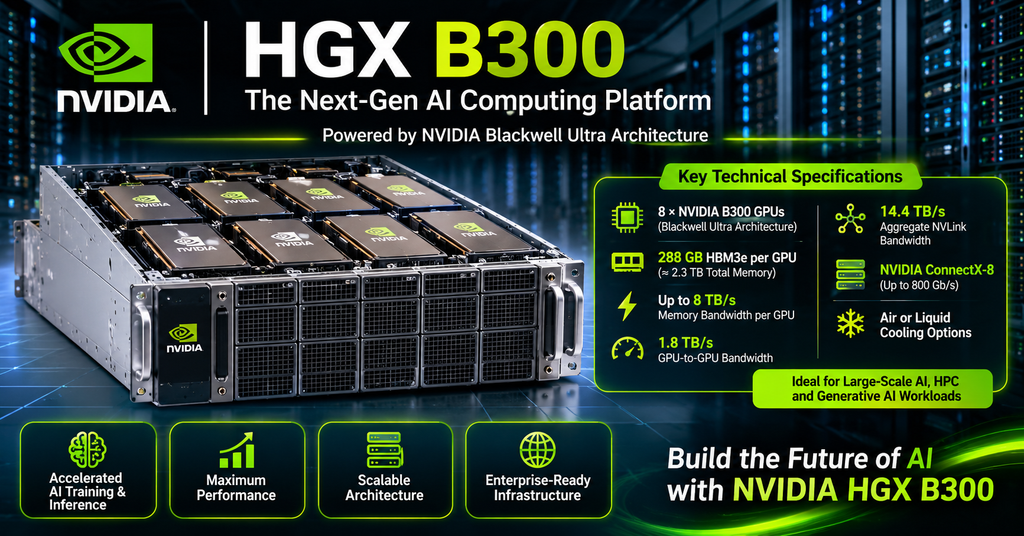
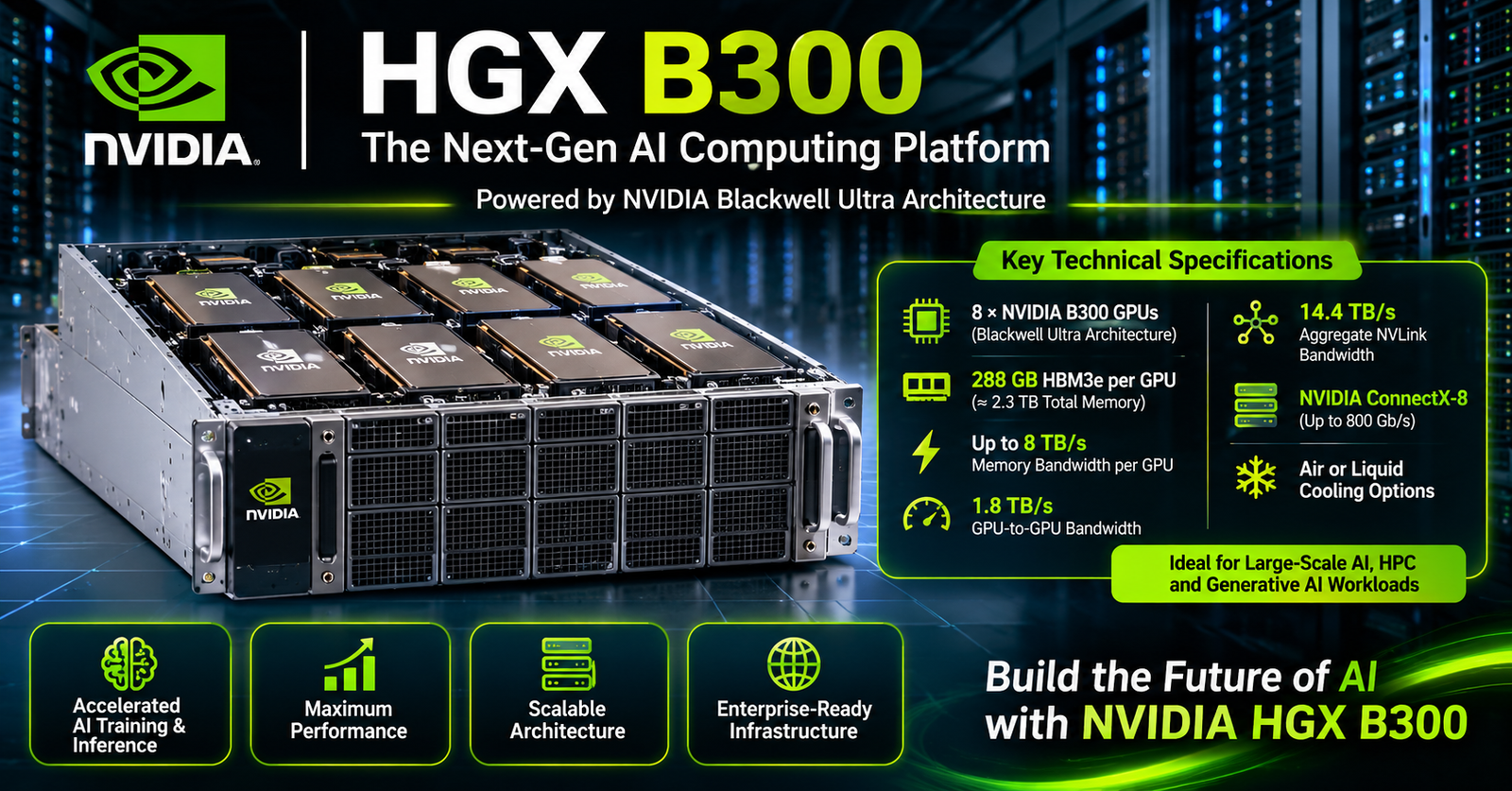
The NVIDIA HGX B300 is an advanced AI computing platform powered by NVIDIA’s Blackwell Ultra GPU architecture. Designed for large-scale artificial intelligence training, generative AI, high-performance computing (HPC), and enterprise AI inference, HGX B300 represents a significant advancement in GPU-based data-centre infrastructure.
Built around eight NVIDIA Blackwell Ultra B300 GPUs, the platform provides substantial GPU memory capacity, high-speed interconnects, and advanced networking capabilities to support demanding AI workloads.
The HGX B300 is particularly suitable for organisations developing and operating:
- Large Language Models (LLMs).
- Generative AI applications.
- Multimodal AI models.
- AI reasoning and agentic AI systems.
- Large-scale deep learning workloads.
- Scientific computing and HPC.
- Enterprise AI infrastructure.
- Real-time AI inference platforms.
Unlike conventional GPU servers, NVIDIA HGX B300 uses a tightly integrated eight-GPU architecture connected through fifth-generation NVIDIA NVLink and NVSwitch technology.
This architecture enables GPUs to communicate at extremely high bandwidth, reducing communication bottlenecks during distributed AI model training.
NVIDIA HGX B300 is available through multiple server manufacturers and infrastructure partners, including Supermicro, Lenovo, HPE, Cisco, GIGABYTE, and Netweb.
Official product information: https://www.nvidia.com/en-us/data-center/hgx/
2. What Is NVIDIA HGX B300 Architecture?
NVIDIA HGX B300 is an eight-GPU accelerated computing platform built using NVIDIA Blackwell Ultra SXM GPU modules.
Its architecture combines:
- Eight NVIDIA B300 Blackwell Ultra GPUs.
- Fifth-generation NVLink interconnect.
- NVIDIA NVSwitch technology.
- High-bandwidth HBM3e GPU memory.
- NVIDIA ConnectX-8 networking.
- High-performance dual-socket server CPUs.
- Enterprise-grade DDR5 system memory.
- High-speed NVMe storage.
- Advanced air or liquid cooling solutions.
The eight GPUs work together as a unified computing environment, allowing AI developers to distribute computational workloads across multiple GPUs.
One of the platform’s major advantages is its ability to handle extremely large AI models without relying exclusively on traditional CPU-to-GPU communication.
Key architectural components
1. Blackwell Ultra GPU architecture
The B300 GPU is based on NVIDIA’s Blackwell Ultra architecture, designed to improve AI training and inference performance, particularly for large-scale reasoning models and generative AI applications.
2. NVLink 5 interconnect
Fifth-generation NVLink provides up to 1.8 TB/s of GPU-to-GPU bandwidth per GPU, enabling fast communication between GPUs.
3. NVSwitch technology
NVSwitch connects the eight GPUs into a high-bandwidth communication fabric, allowing efficient collective operations and distributed training.
4. ConnectX-8 SuperNIC
NVIDIA ConnectX-8 networking provides up to 800 Gb/s connectivity per adapter for high-speed communication between GPU servers.
5. Advanced memory architecture
Each B300 GPU incorporates high-bandwidth HBM3e memory, providing the capacity required for large model parameters, training datasets, and inference workloads.
3. NVIDIA HGX B300 Complete Technical Specifications
The following table summarises the principal NVIDIA Blackwell Ultra HGX B300 platform specifications.
| Technical parameter | NVIDIA HGX B300 |
|---|---|
| GPU architecture | NVIDIA Blackwell Ultra |
| GPU model | NVIDIA B300 SXM |
| Number of GPUs | 8 |
| GPU form factor | SXM |
| GPU memory | 288 GB HBM3e per GPU |
| Aggregate GPU memory | Approximately 2.3 TB |
| GPU memory bandwidth | Up to 8 TB/s per GPU |
| GPU interconnect | Fifth-generation NVLink |
| GPU-to-GPU bandwidth | Up to 1.8 TB/s |
| Aggregate NVLink bandwidth | 14.4 TB/s |
| NVSwitch | Fifth-generation NVSwitch |
| FP4 Tensor performance | 144 PFLOPS sparse / 108 PFLOPS dense |
| FP8/FP6 Tensor performance | 72 PFLOPS |
| FP16/BF16 Tensor performance | 36 PFLOPS |
| TF32 Tensor performance | 18 PFLOPS |
| FP32 performance | 600 TFLOPS |
| FP64 performance | 10 TFLOPS |
| Networking | NVIDIA ConnectX-8 |
| Network bandwidth | Up to 800 Gb/s per adapter |
| CPU configuration | Dual-socket, OEM-dependent |
| System memory | DDR5, OEM-dependent |
| Storage | Enterprise NVMe SSDs |
| Cooling | Air-cooled or direct liquid-cooled |
| Deployment | Enterprise data centres and AI clusters |
Important memory specification note: NVIDIA documentation presents both 270 GB and 288 GB figures for B300 GPU memory, depending on the specification presentation and unit convention. Enterprise reference architecture documentation identifies 288 GB per GPU, or approximately 2.3 TB across eight GPUs. Some platform datasheets present approximately 2.1 TB of fast memory. Buyers should verify the exact memory capacity and reporting convention in the OEM bill of materials.
Official technical references:
- https://resources.nvidia.com/en-us-blackwell-architecture/blackwell-ultra-datasheet
- https://docs.nvidia.com/enterprise-reference-architectures/hgx-ai-factory/latest/components.html
4. NVIDIA B300 GPU Performance and Computing Capabilities
The B300 GPU is designed for demanding AI computing environments where memory capacity, tensor performance, and GPU communication bandwidth are critical.
FP4 performance
FP4 is particularly relevant for modern AI inference workloads, where lower-precision calculations can improve performance and memory efficiency when supported by the model and software.
The HGX B300 platform provides:
- 144 PFLOPS of sparse FP4 Tensor Core performance.
- 108 PFLOPS of dense FP4 Tensor Core performance.
This makes it suitable for large-scale AI inference, reasoning workloads, and models using low-precision quantisation.
FP8 and FP6 performance
The platform delivers up to 72 PFLOPS of FP8/FP6 Tensor Core performance under NVIDIA’s published specifications.
These formats are useful for deep learning training and inference where numerical precision and computational throughput must be balanced.
FP16 and BF16 performance
HGX B300 delivers 36 PFLOPS of FP16/BF16 Tensor Core performance.
These formats are widely used in neural network training, transformer architectures, and large-scale deep learning.
GPU memory bandwidth
Each B300 GPU provides up to 8 TB/s of memory bandwidth.
Across eight GPUs, the platform provides substantial aggregate memory bandwidth for moving model parameters, activations, and intermediate computational data.
5. NVIDIA NVLink 5 and NVSwitch Architecture
One of the biggest advantages of NVIDIA HGX B300 is its fifth-generation NVLink connectivity.
Traditional multi-GPU systems can experience performance bottlenecks when transferring information between GPUs.
NVIDIA addresses this problem using NVLink and NVSwitch.
The HGX B300 platform provides:
- Up to 1.8 TB/s GPU-to-GPU bandwidth.
- 14.4 TB/s aggregate NVLink bandwidth.
- Eight interconnected Blackwell Ultra GPUs.
- High-speed communication for distributed AI workloads.
This architecture is particularly beneficial when training large transformer models that require frequent communication between GPUs.
Applications include:
- Large language model training.
- Distributed deep learning.
- Mixture-of-Experts architectures.
- Large-scale inference.
- Multimodal AI.
- Scientific simulations.
6. Networking Capabilities of NVIDIA HGX B300
Networking is an essential part of an AI infrastructure deployment.
HGX B300 supports NVIDIA ConnectX-8 SuperNIC technology, providing up to 800 Gb/s network connectivity per adapter.
This is important when multiple HGX B300 servers are connected to build larger AI computing clusters.
Key networking capabilities include:
- NVIDIA ConnectX-8 SuperNIC.
- Up to 800 Gb/s per adapter.
- High-speed Ethernet and supported VPI networking configurations.
- Scalable GPU-to-GPU communication across servers.
- Integration with NVIDIA Spectrum-X networking.
- Support for high-performance AI cluster networking.
For large deployments, buyers should also consider network switches, optical transceivers, cables, rack infrastructure, and the required network topology.
A single HGX B300 server is not equivalent to a complete AI cluster. Cluster networking must be designed separately according to the number of nodes and workloads.
7. Server Configuration and Cooling Requirements
NVIDIA HGX B300 is available through different OEM server designs.
Depending on the manufacturer, the system may use air cooling or direct liquid cooling.
Air-cooled HGX B300
Air-cooled systems are suitable for data centres with adequate cooling infrastructure and sufficient power capacity.
Advantages:
- Familiar data-centre deployment model.
- Easier integration into conventional server environments.
- No requirement for direct-to-chip liquid cooling loops.
- Suitable for selected enterprise AI deployments.
Example: Supermicro SYS-822GS-NB3RT.
Liquid-cooled HGX B300
Liquid-cooled configurations are designed for higher-density deployments and demanding thermal environments.
Advantages:
- Improved heat removal.
- Greater rack density potential.
- Better suitability for high-performance AI clusters.
- Reduced dependence on conventional air cooling.
Example: Supermicro SYS-422GS-NB3RT-LCC.
A published Cisco/Supermicro liquid-cooled configuration uses a 4U chassis, eight B300 GPUs, dual-socket Intel Xeon processors, eight ConnectX-8 800 Gb/s network interfaces, and redundant power supplies.
Cooling infrastructure, coolant distribution units, rack power distribution, and facility water temperatures must be evaluated before purchasing.
8. NVIDIA HGX B300 vs HGX B200 vs HGX H200
Organisations comparing AI infrastructure should understand the differences between NVIDIA HGX B300, B200, and H200.
| Specification | HGX B300 | HGX B200 | HGX H200 |
|---|---|---|---|
| Architecture | Blackwell Ultra | Blackwell | Hopper |
| Number of GPUs | 8 | 8 | 8 |
| Memory per GPU | 288 GB | 180 GB | 141 GB |
| Total GPU memory | 2.3 TB | 1.44 TB | 1.13 TB |
| Memory technology | HBM3e | HBM3e | HBM3e |
| GPU memory bandwidth | Up to 8 TB/s | Up to 8 TB/s | 4.8 TB/s |
| NVLink generation | Fifth | Fifth | Fourth |
| Aggregate NVLink bandwidth | 14.4 TB/s | 14.4 TB/s | Platform-dependent |
Why choose HGX B300?
HGX B300 is particularly attractive for organisations that need:
- More GPU memory per accelerator.
- Higher AI inference throughput.
- Large-scale reasoning model deployment.
- Advanced generative AI infrastructure.
- Greater memory capacity for large AI models.
Why choose HGX B200?
HGX B200 remains an option for businesses seeking Blackwell-generation infrastructure with lower memory capacity requirements or different procurement budgets.
Why choose HGX H200?
HGX H200 can be suitable for organisations with existing Hopper infrastructure, established software environments, or workloads that do not require the additional memory capacity and performance of Blackwell Ultra.
9. NVIDIA HGX B300 Pricing in 2026
One of the most important considerations when purchasing NVIDIA HGX B300 is the overall system cost.
NVIDIA does not publish a universal retail price for the HGX B300 platform.
Pricing depends on:
- Eight B300 GPU modules.
- Server manufacturer and model.
- CPU configuration.
- DDR5 system memory.
- NVMe storage capacity.
- Networking components.
- Air or liquid cooling.
- Warranty and technical support.
- Shipping, import duties, and local taxes.
- Delivery schedule and order quantity.
Indicative international pricing
Public market listings and reseller quotations observed during 2026 indicate that a complete eight-GPU HGX B300 server can cost approximately USD 500,000–650,000 for many configurations, with higher-priced enterprise systems and premium configurations exceeding this range.
The following are market reference points, not guaranteed supplier quotations.
| Market / price reference | Indicative price | Pricing basis |
|---|---|---|
| United States | $518,000–$600,000 | Public starting listings for selected HGX B300 servers |
| United States, premium configurations | $600,000–$800,000+ | Higher-end configurations and reseller quotations |
| Europe | €408,000–€450,000+ | Selected published reseller starting prices, excluding VAT |
| Europe, premium configurations | €500,000–€700,000+ | Higher-priced listings and enterprise configurations |
| India | Custom quotation | No sufficiently verified public hardware price |
| UAE | Custom quotation | Regional enterprise procurement |
| Singapore | Custom quotation | OEM/distributor procurement |
| Japan | Custom quotation | OEM and enterprise procurement |
| United Kingdom | Custom quotation | OEM and reseller procurement |
Pricing methodology: US and European figures are based on publicly reported listings and reseller starting prices, not official country-specific NVIDIA MSRP. The prices are not directly comparable unless the GPU configuration, CPU, memory, storage, cooling, warranty, taxes, and shipping terms match.
Useful price references:
- https://www.amcompute.com/managedgpus/b300
- https://www.geniushpc.com/servers/b300
- https://lineagetech.co/products/nvidia-hgx-b300
- https://www.ancapex.io/b300-price
10. NVIDIA HGX B300 Suppliers by Country
NVIDIA HGX B300 systems are supplied through OEM manufacturers, authorised channel partners, enterprise infrastructure distributors, and specialist AI server integrators.
The following supplier directory identifies potential procurement channels by market.
A. United States
The United States has several major enterprise server manufacturers and specialist infrastructure resellers offering HGX B300 configurations.
1. Supermicro
Website: https://www.supermicro.com/
Example system: SYS-822GS-NB3RT.
Supermicro offers HGX B300 server configurations with eight GPUs and air or liquid cooling options.
2. Dell Technologies
Website: https://www.dell.com/
Dell’s PowerEdge AI server portfolio includes B300-compatible enterprise infrastructure configurations. Contact Dell enterprise sales for the exact HGX B300 model and availability.
3. HPE
Website: https://www.hpe.com/
HPE offers advanced AI infrastructure through its Compute portfolio, including HGX B300-based configurations.
4. Lenovo
Website: https://www.lenovo.com/
Lenovo ThinkSystem SR680a V4 is an NVIDIA HGX B300-certified server platform.
5. GIGABYTE
Website: https://www.gigabyte.com/Enterprise
GIGABYTE provides high-performance GPU server systems for AI training and enterprise computing.
B. India
India is an important emerging market for AI infrastructure, data-centre development, and enterprise GPU computing.
1. Netweb Technologies
Website: https://www.netwebindia.com/
Netweb is an Indian high-performance computing and AI infrastructure manufacturer.
Its NVIDIA HGX B300-certified system is listed as CDI300E1HG-108 in NVIDIA’s certified systems directory.
Potential applications include:
- Enterprise AI infrastructure.
- Large language model training.
- AI research.
- Government and institutional HPC.
- Data-centre GPU deployments.
2. NVIDIA India
Website: https://www.nvidia.com/en-in/
Businesses can contact NVIDIA India to identify suitable HGX B300 system partners and enterprise procurement channels.
3. Cyfuture
Website: https://cyfuture.ai/
Cyfuture provides AI infrastructure and GPU cloud services in India. Its HGX B300-related materials include server configuration and infrastructure information.
Buyers should distinguish between purchasing a physical server and renting GPU computing capacity.
C. Germany and European Union
Europe has several AI server suppliers and enterprise hardware resellers.
1. Genius HPC
Website: https://geniushpc.com/servers/b300
Genius HPC publishes configurations and indicative prices for multiple NVIDIA B300 server models, including:
- Supermicro SYS-822GS-NB3RT.
- Supermicro SYS-422GS-NB3RT-LCC.
- Lenovo ThinkSystem SR680a V4.
- GIGABYTE HGX B300 systems.
2. WOW Innovation
Website: https://www.wowinnovation.eu/
WOW Innovation GmbH has published commercial offers for NVIDIA HGX AI server infrastructure. Previous offers should not be treated as current quotations; buyers should request an updated offer.
3. Lenovo Europe
Website: https://www.lenovo.com/
Lenovo provides enterprise server procurement and support across European markets.
4. Supermicro Europe
Website: https://www.supermicro.com/
Contact Supermicro or its regional distribution partners for HGX B300 availability and delivery.
D. United Arab Emirates and GCC
The UAE is a growing market for enterprise AI infrastructure, data-centre expansion, and high-performance computing.
1. Omnixon Global
Website: https://omnixonglobal.com/brands/nvidia
Omnixon lists NVIDIA HGX B300 and DGX B300 hardware within its enterprise IT hardware portfolio and serves the UAE and wider GCC market.
Buyers should confirm the exact product model, authorised supply channel, stock availability, warranty, and import arrangements.
2. NVIDIA Middle East
Website: https://www.nvidia.com/
Contact NVIDIA’s regional enterprise sales team for appropriate AI infrastructure partners and procurement guidance.
E. Singapore
Singapore is an important regional technology and data-centre procurement market.
Potential OEM procurement channels include:
1. Supermicro
2. Lenovo
3. Dell Technologies
4. HPE
https://www.hpe.com/sg/en/home.html
Contact the regional enterprise sales teams to confirm B300-specific configurations, local distribution, and delivery timelines.
F. Japan
Japan has an established HPC, semiconductor, and enterprise AI infrastructure market.
Potential procurement channels include:
1. Lenovo Japan
2. Dell Technologies Japan
3. Supermicro
4. GIGABYTE Enterprise
https://www.gigabyte.com/Enterprise
The exact availability of HGX B300 systems should be confirmed with each manufacturer’s Japanese enterprise sales channel.
G. United Kingdom
Potential enterprise procurement channels include:
1. Dell Technologies UK
2. HPE UK
https://www.hpe.com/uk/en/home.html
3. Lenovo UK
4. Supermicro
Request a complete eight-GPU system quotation with UK delivery, applicable VAT, support, and installation details.
Supplier verification note: NVIDIA’s certified systems directory is the best starting point for validating whether a specific server model has passed NVIDIA system certification. Inclusion in this directory does not automatically establish that every regional reseller is an authorised NVIDIA distributor.
Official certification directory:
https://docs.nvidia.com/certification-technology/certified-systems/nvidia-certified-systems/
11. What Should Buyers Check Before Purchasing NVIDIA HGX B300?
Purchasing an HGX B300 server requires more than comparing GPU prices.
Businesses should evaluate the complete infrastructure investment.
Hardware configuration
Verify:
- Eight genuine NVIDIA B300 SXM GPUs.
- Correct GPU memory configuration.
- Compatible dual-socket CPUs.
- Sufficient DDR5 ECC system memory.
- Enterprise NVMe storage.
- NVIDIA ConnectX-8 networking.
- NVSwitch configuration.
Power requirements
HGX B300 systems have substantial power requirements.
Depending on the OEM design and configuration, buyers should plan for approximately 14–15 kW of server power capacity as an initial infrastructure budgeting reference.
Confirm the manufacturer’s maximum power draw, PSU redundancy, input voltage, and rack PDU requirements before installation.
Cooling infrastructure
Evaluate whether the selected system requires:
- High-capacity air cooling.
- Direct-to-chip liquid cooling.
- Coolant distribution units.
- Dedicated cooling loops.
- Rack-level thermal management.
Software compatibility
Confirm support for:
- NVIDIA CUDA.
- NVIDIA AI Enterprise.
- NVIDIA NIM.
- NVIDIA TensorRT.
- NVIDIA NeMo.
- NVIDIA NCCL.
- Kubernetes.
- Containerised AI workloads.
Warranty and after-sales support
Ask the supplier to provide:
- Manufacturer warranty.
- GPU replacement terms.
- Technical support SLA.
- Firmware and driver updates.
- On-site maintenance options.
- Delivery and installation commitments.
12. NVIDIA HGX B300 Applications Across Industries
Artificial Intelligence and Machine Learning
HGX B300 provides the computing foundation for developing, training, and deploying advanced AI models.
Financial Services
Financial institutions can use high-performance AI infrastructure for fraud detection, risk modelling, financial analytics, and enterprise AI assistants.
Healthcare
Healthcare research organisations can use GPU infrastructure for medical imaging analysis, computational biology, drug discovery, and scientific research.
Autonomous Systems
Large-scale simulation, computer vision, and autonomous driving model development can benefit from advanced GPU computing.
Cloud Computing
Cloud infrastructure providers can deploy HGX B300 systems to offer dedicated GPU capacity for enterprise AI customers.
Scientific Research
Research institutions can use HGX B300 for scientific simulations, computational modelling, and complex data analysis.
13. HGX B300 vs NVIDIA DGX B300: What Is the Difference?
HGX B300 and DGX B300 are related but different offerings.
NVIDIA HGX B300 is an eight-GPU computing platform that OEMs integrate into their own server designs.
NVIDIA DGX B300 is NVIDIA’s integrated enterprise AI system built around the Blackwell Ultra architecture and supplied as a complete NVIDIA system.
The key differences include:
| Feature | HGX B300 | DGX B300 |
|---|---|---|
| Product type | GPU server platform | Complete NVIDIA AI system |
| GPU configuration | 8 B300 GPUs | 8 B300 GPUs |
| Server manufacturer | Multiple OEMs | NVIDIA DGX |
| CPU | OEM-dependent | Intel Xeon 6776P |
| System design | OEM-specific | NVIDIA-designed |
| Support | OEM and partner | NVIDIA DGX support ecosystem |
| Customisation | Greater OEM flexibility | Standardised NVIDIA configuration |
Official DGX B300 information:
https://www.nvidia.com/en-in/data-center/dgx-b300/
14. Future of NVIDIA HGX B300 in Enterprise AI Infrastructure
The growing adoption of generative AI, advanced reasoning models, and autonomous AI agents is increasing demand for high-performance GPU infrastructure.
NVIDIA HGX B300 is positioned to support organisations that require significant computational capacity for training and running increasingly sophisticated AI models.
Its combination of Blackwell Ultra architecture, large HBM3e memory capacity, fifth-generation NVLink, and high-speed networking makes it an important platform for next-generation AI data centres.
For organisations investing in long-term AI infrastructure, HGX B300 provides a scalable foundation for building enterprise AI factories and large GPU clusters.
15. Conclusion
NVIDIA HGX B300 is a high-performance eight-GPU AI computing platform designed for organisations operating advanced artificial intelligence and high-performance computing workloads.
With eight Blackwell Ultra GPUs, substantial HBM3e memory capacity, 14.4 TB/s aggregate NVLink bandwidth, and ConnectX-8 networking, it provides the hardware foundation for demanding AI training and inference environments.
Although the purchase price is substantial, HGX B300 can be a strategic investment for cloud providers, AI companies, research institutions, and large enterprises that require dedicated high-performance GPU infrastructure.
Before purchasing, organisations should compare multiple OEMs, validate the exact GPU configuration, evaluate cooling and power infrastructure, and obtain country-specific quotations that include taxes, delivery, installation, and warranty.
Frequently Asked Questions (FAQs)
1. What is NVIDIA HGX B300?
NVIDIA HGX B300 is an eight-GPU AI computing platform based on NVIDIA’s Blackwell Ultra architecture. It is designed for large-scale AI training, inference, generative AI, and HPC workloads.
2. How many GPUs are included in an HGX B300 server?
A standard HGX B300 configuration includes eight NVIDIA B300 SXM GPUs.
3. How much memory does NVIDIA HGX B300 provide?
Each B300 GPU has 288 GB of HBM3e memory in NVIDIA’s enterprise reference architecture, providing approximately 2.3 TB across eight GPUs.
4. What is the price of NVIDIA HGX B300?
Indicative 2026 pricing for a complete eight-GPU HGX B300 server is approximately USD 500,000–650,000 for many configurations. Premium configurations can cost considerably more. Final prices depend on the OEM and configuration.
5. Which companies supply NVIDIA HGX B300?
Potential suppliers include Supermicro, Lenovo, HPE, Cisco, GIGABYTE, Netweb, and other NVIDIA-certified system partners.
6. Is NVIDIA HGX B300 available in India?
Indian organisations can explore procurement through Netweb Technologies and other enterprise infrastructure channels. Availability, delivery, and pricing require direct confirmation.
7. What is the difference between HGX B300 and DGX B300?
HGX B300 is an OEM-integrated GPU platform, whereas DGX B300 is a complete NVIDIA-designed enterprise AI system.
8. Does NVIDIA HGX B300 support liquid cooling?
Yes. HGX B300 is available in air-cooled and direct liquid-cooled server configurations, depending on the OEM.
9. What is the NVLink bandwidth of NVIDIA HGX B300?
The platform provides up to 1.8 TB/s GPU-to-GPU bandwidth and 14.4 TB/s aggregate NVLink bandwidth.
10. Is HGX B300 suitable for large language model training?
Yes. Its eight interconnected Blackwell Ultra GPUs, high-bandwidth memory, and high-speed networking make it suitable for large-scale LLM training, fine-tuning, and inference.
Official NVIDIA resources
- NVIDIA HGX: https://www.nvidia.com/en-us/data-center/hgx/
- NVIDIA Blackwell Ultra Datasheet: https://resources.nvidia.com/en-us-blackwell-architecture/blackwell-ultra-datasheet
- NVIDIA Certified Systems: https://docs.nvidia.com/certification-technology/certified-systems/nvidia-certified-systems/
- NVIDIA DGX B300: https://www.nvidia.com/en-in/data-center/dgx-b300/


